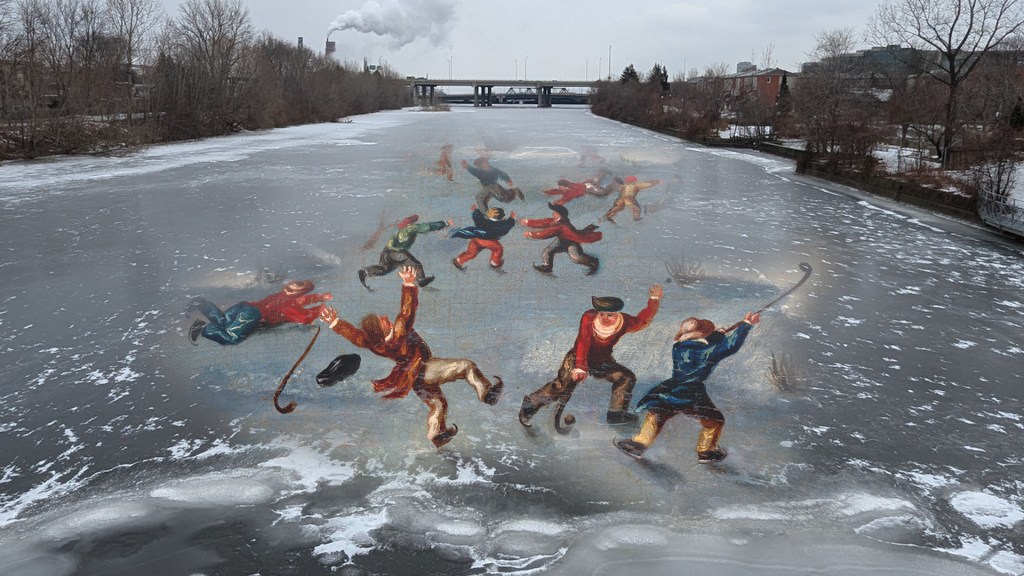
Recent discoveries indicate that the practice of shinty and hurley on ice in North America was first documented in Quebec City.
Two hundred years ago, the Quebec Mercury newspaper reported that citizens of Quebec City played shinty, a ball and stick game, on the ice of the Saint-Charles River on January 1st, 1825.
This is the first contemporary North American mention of the sport now known as « ice hockey. »
And if that weren’t enough, the same newspaper reports that many young people in Quebec City played hurley in the streets of Quebec City in the winter of 1824.
Another historical first on the continent.
These discoveries call into question the status of « first city » for the documented practice of ice hockey, previously attributed to other localities. This includes the cities of Windsor in Nova Scotia, and Délı̨nę in the Northwest Territories.
Shinty, hurley and hockey

The sports mentioned at this precise moment are not called « hockey, » but are recognized synonyms. Scots call it « shinty, » which is also nicknamed « shinny, » a term still used today in Canada to name more or less organized hockey in our streets or outdoor skating rinks. The Irish call it « hurling » or « hurley. » The English first called it « bandy » and later also « hockey. » Other names were also used in the 19th century. Several historians and authors of the time speak of one and the same team sport divided into two clans where, using sticks, one tries to push a ball or object between two posts or any objects placed on the ice. The rules are adapted according to the location and the number of players present. However, it is recognized that organized ice hockey took off at the Victoria Skating Rink in Montreal on March 3, 1875, when it was practiced indoors for the first time, on a delimited surface. The more common practice of this sport at this location, then at the new Quebec Skating Rink three years later (1878), attracted the attention of newspapers. The creation of clubs, tournaments, regulations, leagues and championships in the following decade propelled ice hockey towards universal recognition.
The distinct evolution of hurley and shinty led to the development of unique characteristics specific to each of these sports, which remain today mainly practiced in their regions of origin.
Skates, snow, streets, and boys.

Quebec’s youth undoubtedly had very little to do during the cold winter days of the 18th and 19th centuries. Therefore, the idea of skating and sliding in the frozen streets of Quebec is a common temptation, especially when the river or bodies of water are not suitable for the practice.
On December 24, 1748, Intendant Bigot, moreover, prohibited this dangerous practice:
« Order prohibiting all persons and children from sliding in the streets of Quebec, whether on sleds, skates, or otherwise, under penalty for adults of a ten-pounds fine.«

James Pattison Cockburn (1830), Royal Ontario Museum
Clearly, bladed skates were already available in Quebec City. They were for sale at the cutler Charles Gautier, as advertised in the Gazette de Québec in 1789. Cold winters, such as in 1817 for example, allowed skating on the ice bridge to Île d’Orléans. This was a blessing because fines for practicing it in the city streets were still substantial: in 1822, they were 5 shillings per offender, or 8 days in the correction house.
Certainly, skating or sliding in the streets of several cities was forbidden, but not yet playing team games. This would not be long in coming, because in January 1824, the first mention of a game played in winter in the streets of Quebec City appeared, and it came from a citizen unhappy enough to complain about it in a newspaper.

(…) This game is, I understand, called Hurley, the players are divided into two parties, armed with heavy bludgeons, the one party endeavouring to drive the ball in a certain limit, which the others strive to defend (…)
(…) What adds to the danger is, that hard substances, a lump of ice or a frozen potatoe, for instance, are often substituted for a ball, and being propelled with great force, are capable of inflicting a serious injury (…)
This account by a disgruntled citizen is unintentionally a gem for the history of hockey, as it expresses the very principle of a fashionable winter sport played between two teams armed with sticks and vying for an object that must cross a defined area. It suggests a recent and widespread popularity. This document constitutes the first published mention of the practice of hurley in North America.
However, it’s quite obvious that we’re not talking about hurley on skates, because this resident would certainly have mentioned it. And since skating is prohibited on the streets of Quebec City, it would be rather surprising if that were the case.
An ice surface will be necessary to practice it.
And that’s exactly what seems to be happening a few months later on the Saint-Charles River.
January 1, 1825: a historic moment in Canada.

The following winter, a publication in the Quebec Mercury, on December 21, 1824, announced a shinty match on the « little River, » a nickname sometimes given to the Saint-Charles River (as opposed to the large river, the St. Lawrence River), for New Year’s Day 1825.
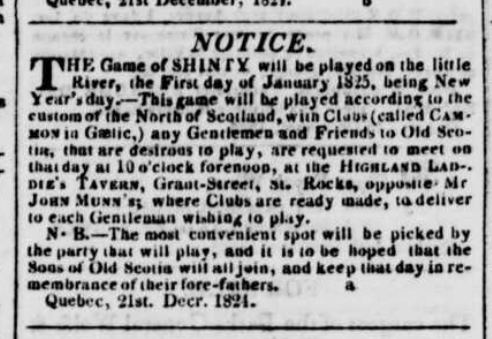
The Game of SHINTY will be played on the little River (i.e., St. Charles River) on January 1st, 1825, New Year’s Day. This game will be played according to the customs of Northern Scotland with sticks (called CAMMON in Gaelic). All gentlemen and friends of old Scotland who wish to play are invited to meet that day at 10:00 o’clock forenoon, at the HIGHLAND LADDIE’S Tavern (1), on Grant Street in Saint-Roch, opposite Mr. John Munn (2), where Clubs will be offered to any gentleman wishing to play. N.B. – The most convenient spot will be picked by the party that will play, and it is hoped that the Sons of old Scotia will all present themselves and commemorate this day for their ancestors.
The text will be republished the following week, then, the Quebec Mercury newspaper reports the event as follows, on January 4, 1825.

On New Year’s Day, a few of the Sons of old Scotia met pursuant to notice at the Highland Laddie Tavern in Saint-Roch, when the national game of Shinty was played with great spirit. A number of the non-Commissioned Officers and privates of the 71st, or Highland Light Infantry, joined the sport, which was conducted throughout with great harmony, and in a manner highly creditable to the parties.
This report was shared in the Gazette de Québec on January 6th, and in the Montreal Herald on the 8th of the same month.

Photo credit: Philip John Bainbrigge. National Gallery of Canada, No. 42222
Examination of this historical event reveals significant organizational elements. The use of specially prepared sticks and the event’s taking place on river ice, in accordance with Scottish tradition, suggests the use of ice skates.
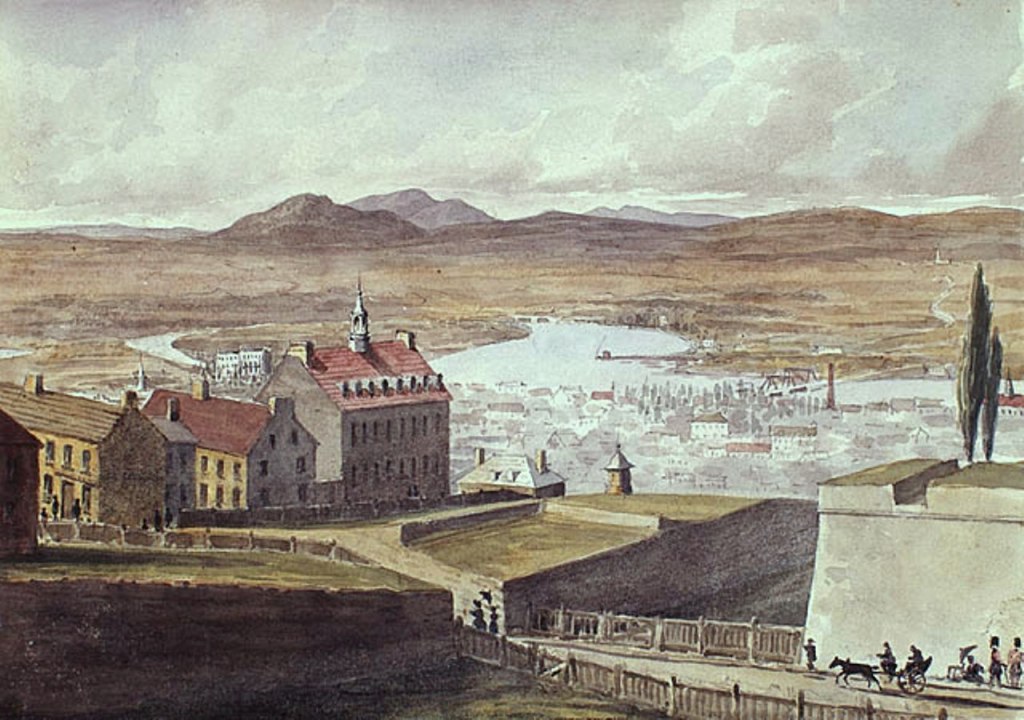
Source: collectionscanada.gc.ca
According to George Penny (1771-1850), in his book « Traditions of Perth, Scotland » written before 1800, « This game is also practiced on the ice by large groups, particularly by skaters, where there is usually fierce competition. » It is also reported that the use of skates is not obligatory, but confers a definite advantage to those equipped with them.
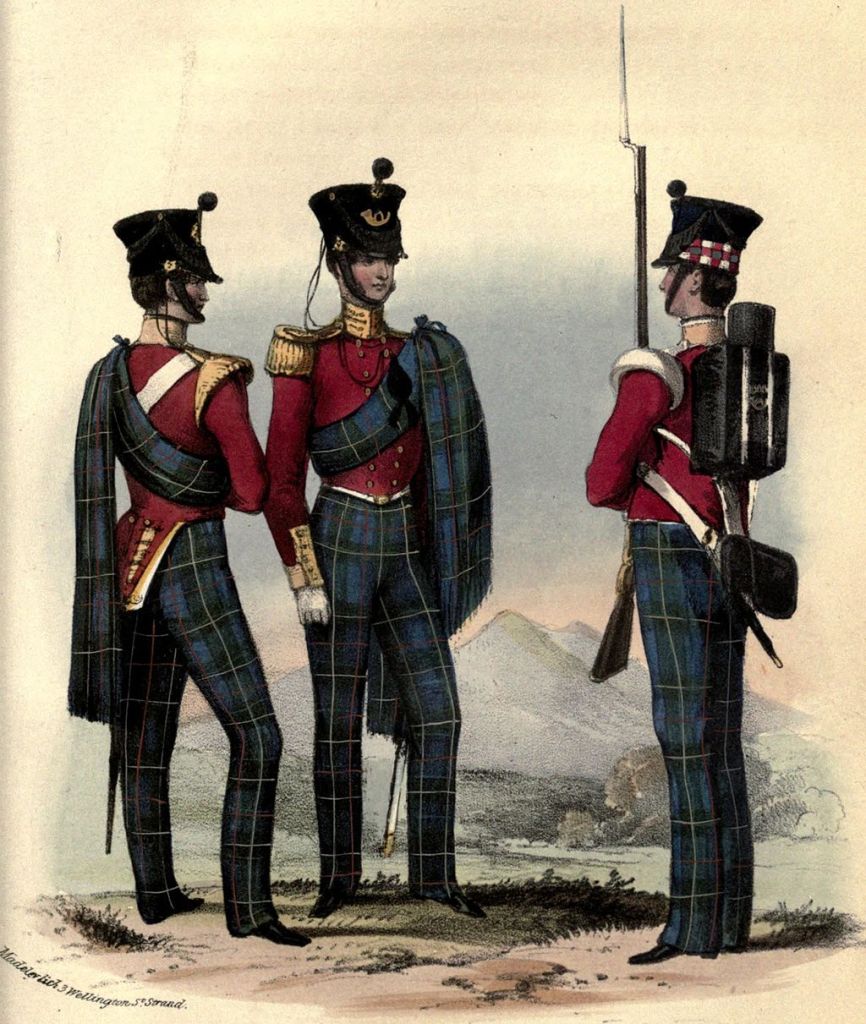
It is interesting to note that the 71st Highland Infantry Regiment was deployed in Ireland before arriving in Quebec City in July 1824, marking its first deployment in North America. The Scottish sporting custom of playing shinty on ice on New Year’s Day would be repeated a few times in Canada, in 1839 in Kingston, Ontario; in Montreal on the Lachine Canal in 1840, and for the same celebration in 1842 in Toronto.
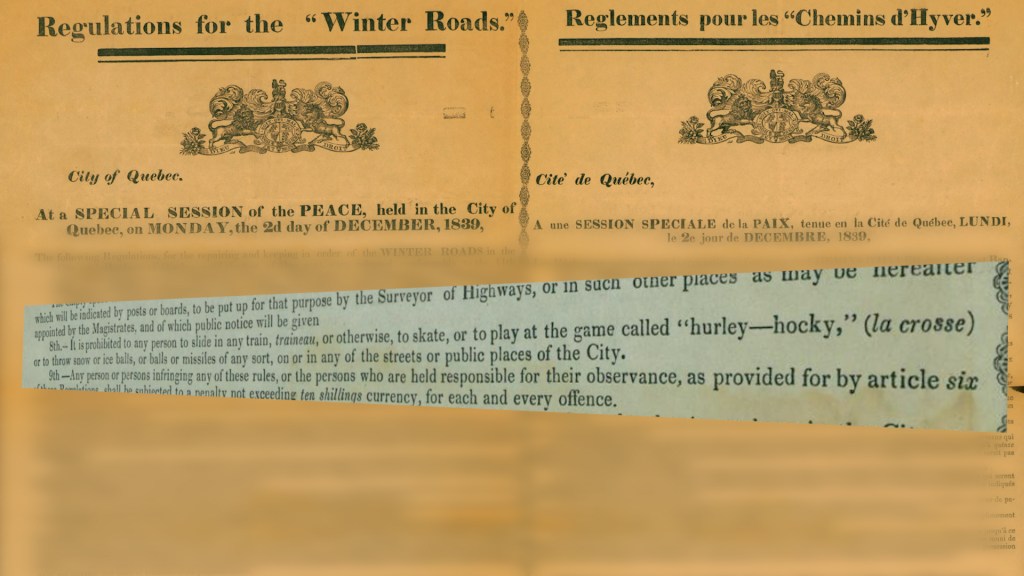
The practice of hurley and shinty in winter, separated by only one summer, proves that the practice of these team sports seems to be growing rapidly in Quebec City, and the disgruntled unknown of Rue Sainte-Anne finally won his point: since 1836, it is now forbidden to play « hurley-hocky » (simply translated as « lacrosse » in French) in the streets and public squares of Quebec City. A sign that this game still bears several names, it is written sometimes « shinty (lacrosse) » in 1840, or simply « hurley » in 1862.
Quebec ahead of Délı̨nę and more credible than Windsor.
Last October, Hockey Night in Canada, on CBC, aired a three-minute segment featuring Délı̨nę, a small town in the Northwest Territories, as the « birthplace of hockey ».

If we accept that hockey is called by various names, the Quebec game on New Year’s Day 1825 precedes the accounts of the English explorer Sir John Franklin (1786-1847) by at least 10 months. Based in Fort Franklin (Délı̨nę) in November 1825, he mentions, in two letters, the practice of a game on ice that he calls « hockey ».
Windsor’s claim in Nova Scotia precedes that of Quebec, but it is based on an anecdotal passage published several decades later.
It was in 1844 that Thomas Chandler Haliburton (1796-1865) recounted the fictional stories of Sam Slick in « The Attaché », who is said to have played « hurly » on the ice of Windsor’s Long Pond, N.S., while studying at King’s College in 1810.

In 2002, a report from the Society for International Hockey Research « concludes that the reference is not a satisfactory indication that the activity fixed in the author’s mind was hockey and
that it actually occurred ».
So, is Quebec the new cradle of hockey? Certainly as much if not more than Windsor or Délı̨nę, but the use of such a slogan remains inappropriate. Hockey is rather the result of an evolution stemming from various games played throughout the world, notably lacrosse, played by Indigenous peoples, including the « Hurons of Lorette » near Quebec City. But the documents found strongly suggest that the city of Quebec, thanks to its harsh winters and its multicultural population, played a significant role in the introduction and development of the ice hockey we know today.
Research and texts: Marc Durand
President, National Capital Region Sports History Society
December 30, 2024.

Quebec’s indoor skating rink, in 1860. It succeeded the one built on Queen’s Wharf in 1851, considered the world’s first covered ice rink.
Photo: Watercolor, E.J. MacGregor, Library and Archives Canada
Notes
(1) The name of the tavern « Highland Laddie » comes from a popular Scottish song with multiple versions dealing with work on maritime construction sites. The popular North American version includes an unexpected reference to Quebec, right from the first verse.
Was you ever in Quebec?
Bonnie laddie, Highland laddie,
Loading timber on the deck,
My bonnie Highland laddie.
(2) In 1823, John Munn the Younger (1788-1859), a renowned shipbuilder and owner, justice of the peace, and politician, decided to transfer his activities to Saint-Roch suburb, to his deceased father’s shipyard, where he moved into a two-story brick house located on the corner of Grant Street (today Monseigneur-Gauvreau Street) and Queen Street. This residence had a small garden planted with trees in the front and a large vegetable garden on the side. (Le Canadien, Quebec City, March 21, 1859, p. 3). It is also located on a street corner from the park that now bears his name, in front of the La Barberie microbrewery.
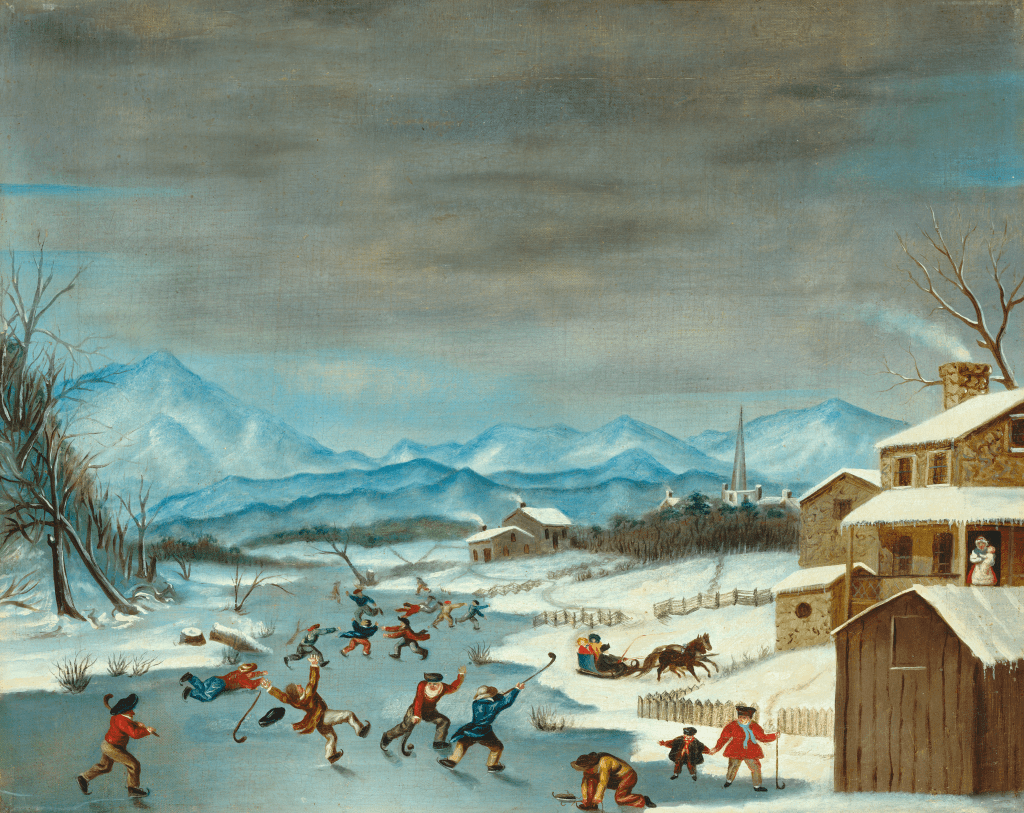
By John Toole – http://www.nga.gov/content/ngaweb/Collection/art-object-page.45857.html, Public Domain, https://commons.wikimedia.org/w/index.php?curid=5090238235 John Toole
 Quebec Bulldogs
Une belle recherche comme on les aime : pertinente et documentée dans ses moindres détails.
C’est avec un grand plaisir que je vous ai lu. Je pense que Donald Guay aurait apprécié.
Bravo, M. Durand. Poursuivez vos recherches, elles sont importantes pour notre patrimoine sportif et national.
Roger Boileau, Ph. D.
Professeur retraité
Merci Monsieur Boileau. Je tiens à exprimer ma profonde admiration pour le travail de recherche et les publications de Donald Guay, dont la qualité demeure impressionnante, malgré les contraintes techniques plus importantes rencontrées à son époque. Je vous remercie également pour votre appréciation et vous souhaite une excellente année 2025.